Is this going to make our neighbourhood less safe?
Side streets typically become safer after traffic barriers are installed, not more dangerous. The crash and injury record on Wellington Street reflects a street dominated by through-traffic, and the shared street option addresses those conditions, improving safety for everyone.
There are two proposed options for Wellington Street in Clifton Hill. This site focuses on the shared street option, which we think serves our community better. See what both options involve.
Register your support now. Local or not, your support counts.
Just add your suburb so we can show councillors both local and broader backing.
The side streets
Some residents have raised concerns about specific streets: Noone, Hodgkinson, Gold, and Council. The concern is that filtering Wellington Street will push displaced traffic onto those roads instead.
The traffic displacement concern is addressed on the traffic page in detail. In short: most vehicles on Wellington Street are rat-running with no origin or destination in the area. When that shortcut is closed, those trips do not simply divert to the next street over. Many trips disappear entirely: people find a different route, combine trips, or stop making the journey by car1. Direct traffic counts across 46 comparable London schemes found little indication of systematic displacement to surrounding streets2.
To the extent that some traffic does shift to those streets, the safety record from comparable schemes still points the same way. Road casualties within filtered areas typically fall substantially, because both vehicle volume and vehicle speed are reduced3.
At the school gate
A raised zebra crossing at Clifton Hill Primary creates a permanent, physically enforced pedestrian crossing at the school gate. The shared street option also reduces the speed limit on the southern sub-section (Alexandra Parade to Hodgkinson Street, which includes the school gate) from 40 to 30 km/h. The risk of a pedestrian fatality in a collision falls substantially at 30 km/h compared to 40 km/h4. Option 2 makes no speed limit change. More detail is on the school page.
Wellington Street already has a serious crash record
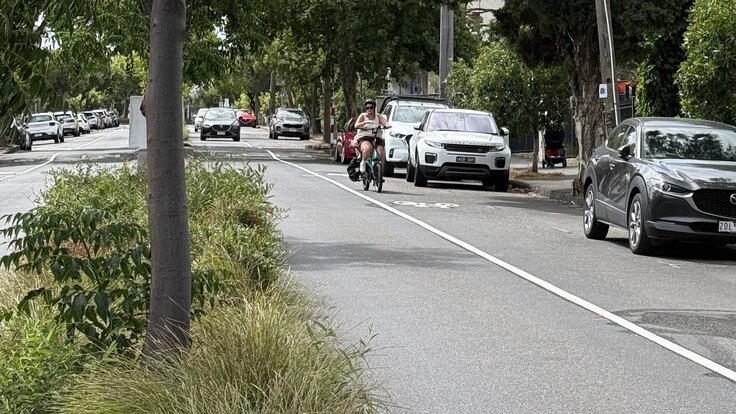
Around 70% of crashes on the full Wellington Street corridor involve at least one cyclist and cyclists are at least twice as likely as drivers to be seriously injured on this street5. In the Clifton Hill section specifically, two-thirds of crashes involved a cyclist. Every pedestrian victim recorded in that section was struck by a motor vehicle; not one was injured in a bicycle crash6.
The speed limit reduction and traffic reduction together address the conditions producing this record. Yarra Council reports a 51% reduction in all crashes and a 70% reduction in serious crashes in the 30 km/h trial area, based on its review of Victorian Government crash data comparing five years before the trial to five years after7. Road casualties on comparable filtered streets fell by approximately 35%, with deaths and serious injuries falling by a similar margin3.
Option 2 in comparison
Option 2 installs physically separated cycling lanes but makes no speed limit change and includes no traffic barriers on the southern sub-section. It changes the cycling infrastructure but not the volume or speed of motor traffic that produces the current crash record.
Nighttime safety
Residents have raised concerns about walking home after dark from parking that is further away.
Street safety at night depends primarily on pedestrian activity. Filtered streets increase foot traffic rather than reduce it, typically decreasing crime rates8.
-
Cairns, S., Atkins, S. & Goodwin, P. (2002). “Disappearing traffic? The story so far.” Proceedings of the ICE - Municipal Engineer, 151(1), 13–22. The 14-16% median area-wide reduction finding is consistent with the later Barcelona study: Nello-Deakin, S. (2022). “Exploring traffic evaporation: Findings from tactical urbanism interventions in Barcelona.” Case Studies on Transport Policy, 10(4), which found a -14.8% average (-15.4% median) net reduction on intervention streets relative to controls, with adjacent streets rising only 0.7%. See also: Better Streets Australia. ↩
-
Thomas, A. & Aldred, R. (2023). “Changes in motor traffic in London’s Low Traffic Neighbourhoods and boundary roads.” Case Studies on Transport Policy. Covered 46 LTN schemes across 11 London boroughs; found a median -32.7% reduction in motor traffic on internal roads, with little indication of systematic displacement to boundary roads. ↩
-
Furlong, J. et al. (2025). “Low Traffic Neighbourhoods in London reduce road traffic injuries: a controlled before-and-after analysis (2012-2024).” Injury Prevention. Controlled study of 113 LTN schemes in London over 2012 to 2024; found a 35% reduction in all injuries (95% CI: 29-40%) and 37% reduction in killed or seriously injured (95% CI: 24-48%) inside LTNs, with no change on surrounding boundary roads. ↩ ↩2
-
World Resources Institute, Cities Safer by Design (2015), provides an accessible overview of the speed-injury relationship. Speed-fatality estimates vary by study methodology; see the school page footnote for the Victorian government’s own figures. ↩
-
YourSay Yarra, Learn more about this project. ↩
-
Victorian Road Crash Data (Department of Transport and Planning, 2012–May 2025). Full Wellington Street corridor (Yarra LGA): 141 cyclists injured (31 serious, 110 other); 12 pedestrians injured, all in motor vehicle crashes, none in bicycle crashes. Clifton Hill segment (Stage 4, Alexandra Parade to Queens Parade): 50 crashes; 33 involved at least one cyclist; 3 pedestrian victims (1 serious injury, 2 other injury), all from motor vehicle crashes, none from bicycle crashes. ↩
-
Yarra City Council, review of Victorian Government road crash data, comparing the five years before the 30 km/h trial (from 2013) to the five years following its introduction (from 2018). Figures cited on YourSay Yarra: Learn more about this project under “How do these kinds of treatments work in conjunction with 30km/h speed limits like the one currently trialled in Fitzroy and Collingwood?”. ↩
-
Goodman A. and Aldred R. (2021). “The Impact of Introducing a Low Traffic Neighbourhood on Street Crime, in Waltham Forest, London.” Findings, doi:10.32866/001c.19414. Residents increased walking by 21% following implementation. Violence and sexual offences fell 18% and burglary fell 10% in the Waltham Forest scheme. The UK Department for Transport’s 2024 evidence review of multiple LTN schemes found less street crime within LTNs broadly, with no evidence of displacement to surrounding areas: Department for Transport, Low Traffic Neighbourhoods Research report (March 2024). ↩